
I first encountered “Against the Grain” when my uncle, a San Luis Obispo local, handed me a copy of the zine. A year later, I met the creator, Matt Cross, on the back patio of Linnaea’s Cafe. I instantly recognized him from two things: the colorful copies of “Against the Grain” under his arm and the face I had seen on a bottle of Matt Cross Hot Sauce in my uncle’s fridge.
Cross was originally a pastor for the Christian Church but left the faith a few years after moving to San Luis Obispo. As we sat down with our coffees — mine a dirty chai, his a black coffee — he joked that studying to be a pastor didn’t leave him with a lot of transferable skills, so he turned to a career in music.
But he didn’t stop there. He makes his own hot sauce, he briefly owned a pub and he’s thinking about getting into bootleg spirits next. Above all else, he’s an artist, and the zine came from a desire to share his creativity with the world.
Cross published “Against the Grain” for a year, between January and December 2025, with the goal that it would act as “analog social media.”
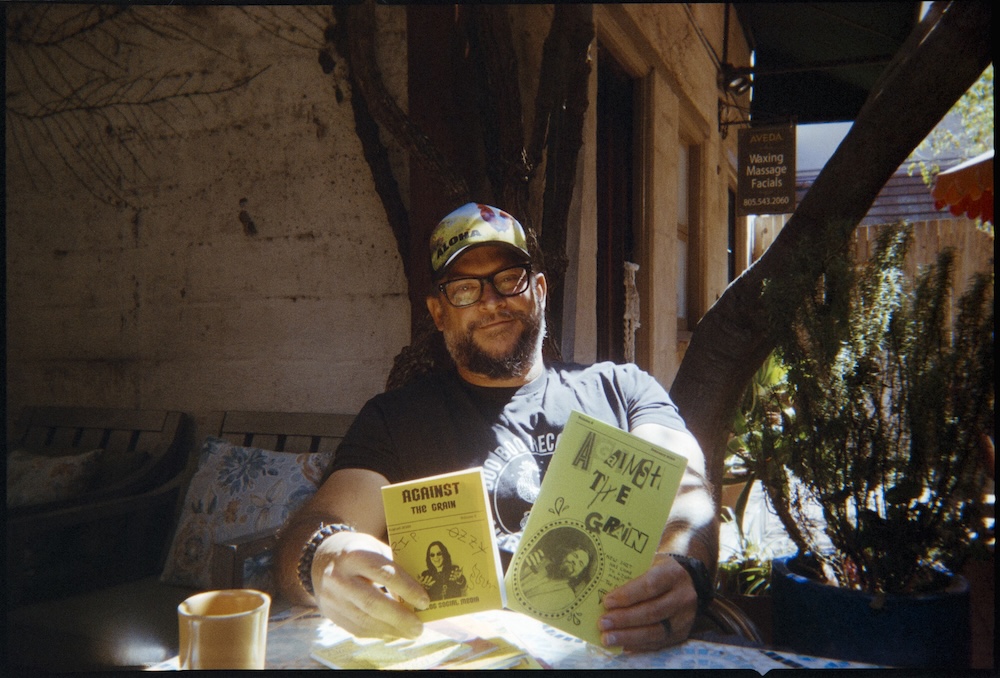
“Zines were a thing back in my day, like when I was a teenager and starting college,” he said. “You’d see them all over the place, and it was the only place to really find out about stuff. Now it’s all just social media.”
But Cross was fed up with social media. He tried to quit it altogether, but found difficulty in promoting his music without it. When AI began to emerge, it worried him even more.
“I can’t stand that s**t,” he said “It draws you in because, yeah, it does make things easier, but it’s robbing our society of creativity.”
So, he made “Against the Grain” as his small way of pushing back against the tidal wave of AI and social media. The zine started as a collection of Cross’ own art and writing, but he quickly amassed a loyal crew of colorful contributors.
The zine ran for 12 issues and contained art, poetry, essays, opinions — anything that readers submitted to the email address at the back of each issue. In this way, it truly became a form of “analog social media,” where anyone could share their thoughts, creations and expressions freely.
One frequent columnist was a bouncer called Big Fish, a tough-looking guy, who wrote stories on his career in a segment called “Bouncer S**t.”
“He scared me,” Cross said, but Big Fish surprised him in every way.
“He was such a good writer. I learned more and more about him,” Cross said. “He’s Jewish, and he fights for trans rights. He married a porn star. He looks like he’s super right-wing, but he’s super liberal.”
Cross eventually convinced Big Fish to start writing a book. This is what Cross does best – noticing the creativity that exists within others and coaxing it to the surface.
“Don’t judge yourself. Put it out there. Just do it,” he said.
He’s lived his life by these words, insisting on making art even when the world tells him not to.
As a kid, Cross was encouraged to play football. He gave it a try, but realized he didn’t like sports. One of his articles in “Against the Grain” focused on this experience of lacking what he calls the “man gene.” He thinks football is lame, he doesn’t like violence and he values artists above athletes.
It’s clear that Cross doesn’t make art solely for the purpose of expression. It’s an active practice of rebellion against the expectations imposed upon him.
During the COVID-19 lockdown, Cross played a series of free, socially-distanced concerts on Terrace Hill in San Luis Obispo. These shows, in true Matt Cross fashion, were purely analog – no pedals, no processors, just a guitar and a voice. He was shocked when a crowd of about 200 people showed up because there was nothing else to do.
Eventually, city officials caught wind of the shows and contacted Cross about obtaining a permit to perform.
“You want me to pay you to do shows for free for people during COVID?” he said. “You might wanna rethink that.”
Cross said the city only found out about the shows because was posting them on his social media. So, the next time he performed on Terrace Hill, he only promoted the show in an issue of “Against the Grain.” The city had no idea.
That’s really the purpose of any zine. When technology fails us, we turn to the things we’ve always known to work — word of mouth, a paper flyer, something tangible and real.
Cross told me about a time he received an angry email from someone who had read one of his articles about leaving Christianity. Instead of ignoring the hate mail, Cross invited the reader to meet him for an in-person conversation. The guy eventually backed off, but Cross welcomed the critique.
“I want people to interact with it and see what they think about it,” Cross said.
When he was publishing “Against the Grain,” he did so anonymously. That way, if the person sitting next to him at Jan’s Vinyl Bar was reading a copy, they would share their honest opinion.
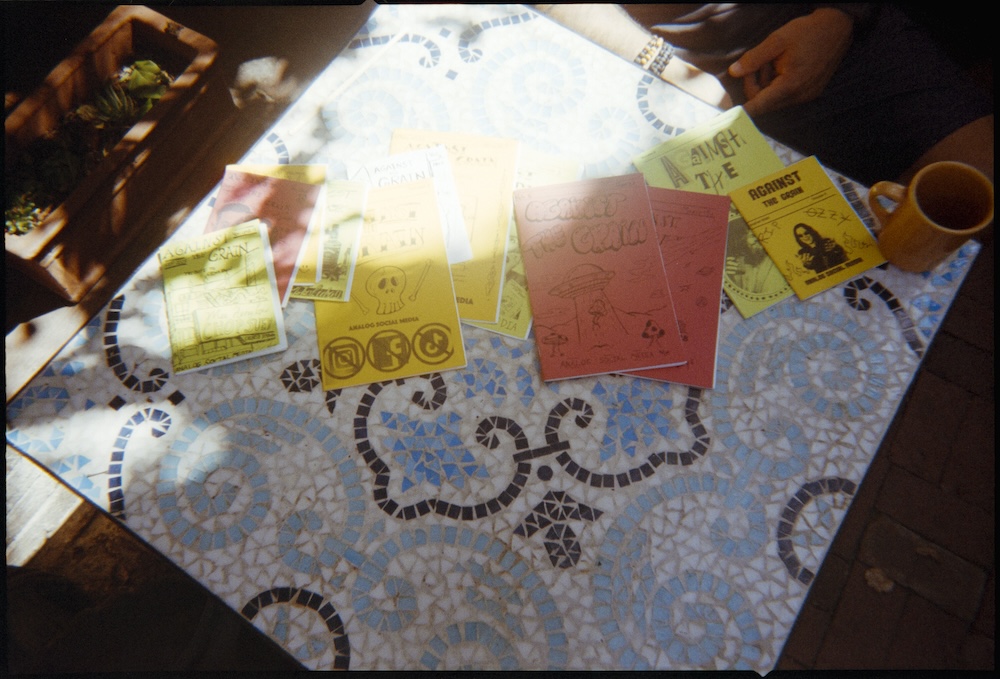
“Against the Grain” was distributed at Jan’s, Linnaea’s and Boo Boo Records during its publication. Cross said he stopped the zine simply because he got bored.
“The only thing I’ve stuck with is my marriage and music,” he said.
There is no doubt that whatever Cross does next will be just as unexpected and inspiring.
As for the advice he wanted to pass on to the next generation of creatives, he said that he lives by the words of lead guitarist and vocalist of the Grateful Dead, Jerry Garcia: “In this life, I choose fun.”

