
As Spotify CEO steps down, the company’s ties to Combat AI remain
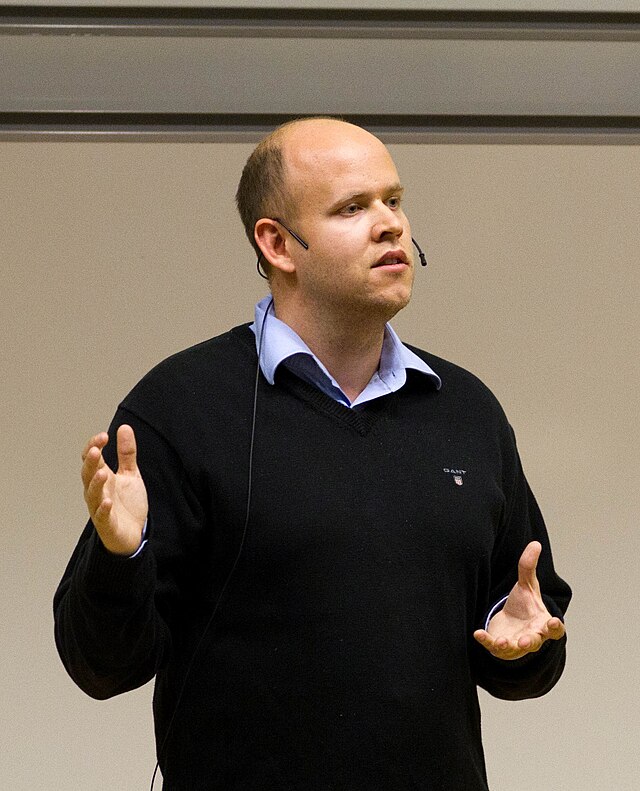
Dylan Koch is a content writer and disc jockey for KCPR. The opinions expressed in this article do not necessarily reflect those of Mustang Media Group.
On Sept. 30, Spotify co-founder Daniel Ek announced that he will be stepping down as the streaming giant’s CEO after 19 years at the helm.
Ek co-founded Spotify with partner Martin Lorentzon in 2006. In the years since, what started as a long shot at success in the music industry has become a $140 billion powerhouse, accounting for nearly 50% of the U.S. music streaming market.
Ek will remain at the company in a less public executive chairman position, focusing on “the long arc of the company, the big strategy decisions [and] the big capital allocation decisions,” according to Forbes.
In a video posted on X, Ek shared the motivator behind the change, explaining that Spotify’s current co-presidents, Gustav Söderström and Alex Norström, have been doing “an amazing job leading [the] company.”
An update from me 👇 pic.twitter.com/xc0w3BWWAO
— Daniel Ek (@eldsjal) September 30, 2025
Ek informed viewers that Söderström and Norström will take over as co-CEOs and that he is ready to loosen his grip, comparing the company to a parent watching their child graduate.
No longer the public face of Spotify, many have been revisiting the last story that landed the streaming service and Ek in the headlines.
In June 2025, Ek used his venture capital firm Prima Materia to invest nearly €600 million (about $700 million) into Helsing, a German combat AI firm, earning himself a seat on the company’s board.
The Munich-based Helsing, now valued at €12 billion, got its start in 2021 after a less public investment from Ek’s Prima Materia, offering a software product that used AI to turn battlefield information into something resembling a “video game.”
Since then, Helsing has pivoted to designing and building physical weapons of war like “strike drones” and “unmanned mini submarines” (TechCrunch).
This news was met with a groundswell of artist opposition to Ek and Spotify.
King Gizzard and the Lizard Wizard, Massive Attack, Xiu Xiu, Hotline TNT, Deerhoof and numerous other musicians publicly announced the removal of their music from Spotify following the announcement.
On June 30, Deerhoof members took to Instagram to express their reasons for leaving the platform.
“We don’t want our music killing people,” the Bay Area post-rock outfit said. “We don’t want our success being tied to AI battle tech … [it] finally solves the perennial inconvenience to war-makers — it takes human compassion and morality out of the equation.”
Some Spotify users, in line with artists like Deerhoof, even went as far as cancelling their subscriptions when the news of Ek’s investment broke.
Junior natural resources management student Ryan Schisler was one of them. Schisler wasn’t surprised to hear that a giant corporation like Spotify was tied to combat AI, but, as a lover of music and active part of the music community on campus, the news “hit close to home.”
“When I read all that stuff, it clicked in my head,” Schisler said. “It can feel difficult to do anything meaningful. Deleting Spotify felt like an opportunity to take a very small, but very real step in the right direction.”
With Ek stepping down from his position as Spotify CEO, the connection between the streaming service and Helsing may seem less concrete; however, Ek is as present at Spotify today as he ever was.
In fact, he now has more control over the fate of the company than he did as CEO. By becoming executive chairman, Ek told Forbes he has gone “from a player to a coach.”
And with his focus now set firmly on “big capital allocation decisions,” it seems that Coach Ek may be in a position that makes large-scale investments of Spotify revenue easier than ever.

