
Highway to Heavenly: Heavenly on their return to the indie pop scene after 30-year hiatus
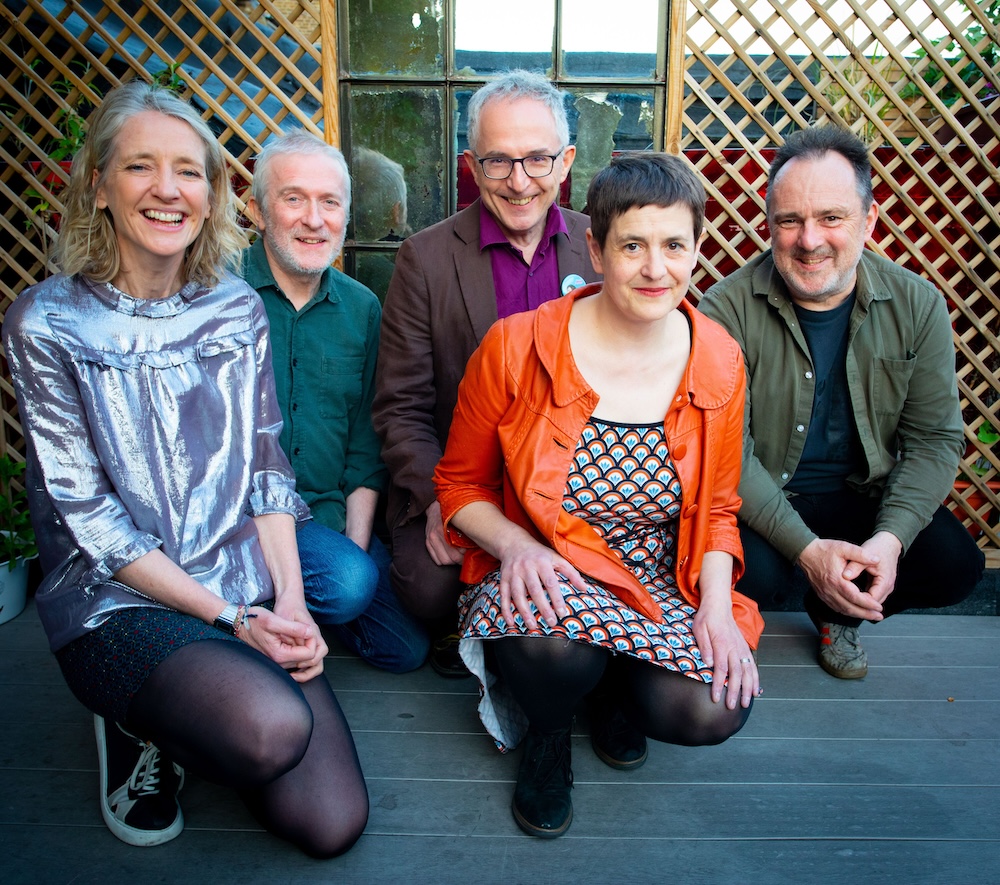
With badges over their hearts and their hearts on their sleeves, English indie pop group Heavenly put out some of the most heartfelt albums of the 1990s. Now, they are back with “Highway to Heavenly”, their first LP in 30 years, an instant classic with an expansive tour that is now approaching its final leg on America’s West Coast.
No longer the bushy-tailed popkids that they once were, Heavenly are now popadults. In the three decades since their last efforts together, they have loved and lost. They’ve started families — and record labels. They’ve grown up, if only a little bit. Heavenly’s new music reflects this maturity, while still being as youthful, clear-eyed and chiming as ever. Heavenly is NOW!
KCPR’s Dylan Koch sat down with songwriter/guitarist Amelia Fletcher, bassist Rob Pursey and guitarist Peter Momtchillof, to discuss the new LP, their return to touring, Sharp Pins, “Portlandia” and the political implications of playing pop in a world gone wrong…
What is Heavenly, for those out there who don’t know?
Amelia: So, Heavenly is a band from the 1990s, actually. So we’re coming back at the moment.
We had realized that people were quite interested in Heavenly and that we were quite interested in Heavenly. So we started again and we have a new album out this year called , which seems to have done pretty well… so, yeah, that’s us. And we’re coming to the West Coast to play some shows!
You led me right into my first question! Wow do you all feel about the word “twee” as a descriptor of music and your music? I think that in ways it leaves a lot to be desired, but it does get thrown around a lot.
Amelia: We struggled with it at first because particularly in the UK and maybe in America as well, that’s a term that was clearly kind of intended to be derogatory. I think it became popularized in the US, where maybe it didn’t quite have that derogatory tone and I think it’s just now become the term for that kind of music. I think there are other types of music that similarly have terms that were derogatory and then just became the word — so we still slightly cringe but we just have to accept it because that’s what people think it is.
Rob: Yeah it’s the same with punk.
Amelia: Yeah, that was a big insult. Rob’s trying to get a particular new term invented, because we are…
Rob: Yes, because Heavenly is definitely at the more Riot-Grrrl and punky end of twee.
So we have a new term which is “Riot-Twee.” So we’d like to think of ourselves not as Twee-pop but Riot twee…It possibly sounds worse.
Going from there and into the new record… this one ventures into some different and new sounds — maybe moving a bit away from an indie pop sound, if you can call it that. What was the process behind the record?
Amelia: We made it over a couple of years. I wrote the songs and then brought them to the band to do their things with. And I guess it is true that although I probably write songs not dissimilar to how I always have written them, the lyrical themes are different and everybody also in the band has their own styles. I guess we’ve all changed the music that we like a little bit, so it probably is the case that people are coming with something slightly different…
Rob: I think that one of the differences maybe is that before we recorded this one, unlike all the other four, we’ve thought about it a bit more before we recorded it! And one of the main ways we thought about it is that you probably noticed that on some of the early Heavenly Records, everybody plays something slightly different all at once…and quite often Amelia and Cathy sing two slightly different things all at once at the same time as all that.
Amelia: Still do that…
Rob: And so it’s a…it’s a delightful mess and we thought maybe we should be a little bit more disciplined in our old age. So that’s maybe a difference and so you tend to find that there’ll be a part where the vocals are in charge, and there’s a part where the guitar’s in charge and then there’ll be a part where the keyboard’s in charge. I don’t think everybody was trying to play everything all the time and on the bass I was probably being a little bit more disciplined than I used to be. Because I was trying to play lead guitar tunes on the bass while the keyboard and the guitar were playing lead guitar tunes as well! So maybe I grew out of that. That’s my analysis.
What about you, Peter?
Peter: Yeah, I think there is less indie pop, if that’s the style. I think people who like the way Heavenly started off will still find…elements of that in the sound. But we hope that they might actually quite like the fact that we’re doing it a bit differently than we used to do. And we changed while we were going in the ’90s, anyway, we sort of went for different kinds of sounds, then some more sort of garagey sounds. I think we’re still trying to renew our sound to make it sound interestingly different while holding on to what we like about the group.
Rob: I think all the things that sound the same are there by default and we can’t do anything about it. We weren’t trying to consciously reproduce anything we’d done before.
Amelia: Obviously there’s an awful lot in there that’s going to sound the same because it’s us doing it but…
Rob: It’s hard doing a new record after such a long time because you kind of you don’t want it to be a pastiche of what you’ve done before, because that will always feel a bit sad, and you don’t really want to self-consciously break out into sort of, I don’t know…
Amelia: …Funk or something.
Rob: Something that you probably couldn’t do, just to try and be dramatically different. So yeah, that’s what I think was going on.
Amelia: Yeah, but when I was writing the songs I was trying to think back to how I wrote songs and writing them in a similar way. I think part of what is Heavenly is all of the people in Heavenly doing their thing. I did quite consciously try and think about what made a Heavenly song, but they’re still kind of different.
How did it feel for you guys to come back after so long and make music together again?
Rob: It was emotional, I mean, I think for us individually it was when we first met to rehearse, because that was the first time we’d been in a room playing these old Heavenly songs. And obviously we were very aware of the lack of Matthew there, because the reason the band stopped was because Matthew left.
Amelia: Matthew was the drummer in Heavenly and my brother. And well, Heavenly stopped because he committed suicide, basically, when he was in his mid-twenties. And so we just, we actually thought we would never do music again. I mean, we really had no intention to do music again. So it was strange when we were in a room together because we were, you know, it had been a really long time. That gap where Matthew was was very clear to the four of us that have been in Heavenly. Obviously, we now have a new drummer, Ian, and part of the reason that I think Heavenly can exist again now is because Ian is so great and so empathetic to, kind of, the position he’s come into.
Rob: With Ian, he’d become a friend of ours for quite some time before he became part Heavenly, we were playing in our other bands with him and we’d just become a friend with him, and we thought he would get on well with Peter and Kathy, as well. It’s interesting that it works, because he was a friend first and then the drummer in the band. I think both of our bands have come about because there’s a group of friends who think they might want to make their friendship musical, because these are people you like hanging out with. So, I think it was emotional because we had to get over that and then, by the time we played the first gig, I guess we had gotten over it. But then when the first gig happened, there’s 400 people or whatever in a room who haven’t got over it and they were very, very emotional and that was quite a surprise to us, because you can tell what an audience is feeling, it’s strange how clear it is, and it was clearly very, very emotional.
Amelia: It was. There were people crying, we were crying…
Rob: …that makes it, oh my god, just turning into this emotional kind of fiesta… but it was great, at the same time because, I think, people were happy that we were there. But I think you kind of don’t realize, that first time you expose the songs again, and yourselves, to an audience, how much it means to people. It sounds a bit pompous to say that, but it came as a bit of a surprise. I thought we were kind of like an ephemeral pop band — we thought we were an ephemeral pop band — because that’s what pop bands are supposed to be. So it came as a bit of a shock that it meant quite a lot to people and it wasn’t quite as ephemeral as we all thought.
That was actually my next question, what the response was like? You covered it beautifully there.
Amelia: Yeah, I mean, the response then was amazing. That was mainly people that had seen us back in the day and I think they were, and what that day kind of represented, was partly, you know, they loved hearing Heavenly again. But partly, I just think it brought everything back in their lives and the time that they’ve had since then. So I think it was an incredible kind of nostalgia-fest for everybody. And people seeing each other, that had known each other years ago and hadn’t seen each other for years. So I think all of our gigs, even now, have a lot of that flavor. But the additional thing is that the gigs now have a whole bunch of young people — because young people seem to have discovered Heavenly and it’s really fantastic at our gigs now, because we have we have very few people who are in their 40s, we have people that are either as old as us and loved us back in the day, or we have really young people and seeing that mix of people… it’s a really brilliant and exciting set of people to have in the audience.
Peter: I think one reason why the reconnection thing was strong was because there wasn’t social media when Heavenly was going for the first time so people didn’t keep up with casual acquaintances so easily, for better or worse. So I think a lot of people were really reconnecting with people. It brought back that time and it allowed people to see those they’d lost touch with and also reconnect with some tastes that they might have lost touch with it’s a long time. That made it an unusual occasion. All of our worlds had changed a lot since the last time we did this.
Speaking of changing worlds, it seems like, and maybe this was also the case a bit in the ’90s but it seems even more dramatic now, that the indie world looks towards nonchalance and irony as the standards that one ought to reach for. This tour, Heavenly coming back, Heavenly playing music and also your label, Skepwax, seem like they are examples to the contrary. How does it feel to play pop music and put it into the world in 2026?
Rob: It feels really good, and I think that with the label, because, I mean, that was the other thing that was happening around the time of Heavenly coming back, is that me and Amelia decided to start a label. When we started it, I wasn’t really sure that labels would really mean anything anymore because back in the day, you had to have a label otherwise no one was going to get your music, because you had to have someone to make the records, whereas that is now clearly not the case. Labels are kind of a different thing now, but they create a kind of milieu sometimes, a virtual milieu, because people will know about other bands and there’ll be a connection between those bands and they may play gigs together and I think that people who like one band will therefore might be taking interest in another. There’s a kind of, I hate to use the word “curation,” but I’ve said it now, there’s some curation, but there’s also a kind of a community going on.
I think that the pop thing, when delivered to an audience, I still find it immensely satisfying that music can be really loud and exciting and quite stirring and not ironic at all, without being rock. So I think that rock has traditionally sort of colonized a lot of what we assume to be great about modern music. We don’t really do excess, you know, we drink a lot of tea — but we make a lot of noise. And I think it is exciting. I don’t think that really goes away. I think it’s really important that the assumption that an alternative to the mainstream would have to be rock is a false assumption. Because most rock, a lot of it is macho and pretty hard-band and tedious. And so, I think it feels like a political act, I suppose with a small-p, but it’s definitely worth sustaining and it’s exciting when it works.
Amelia: I think the other thing is that back in the day in the ’90s, there was actually quite a broad scene and there were plenty of bands who were very into being ironic and nonchalant but we liked them sometimes, some of them, we were just different, but we were still kind of within the same scene. I would say, and they didn’t necessarily like it, some of them liked it, some of them didn’t, you know, but it was a scene. I would say what’s interesting about the current scene is there are bands not dissimilar to some of those bands, like the bands that were on Creation. So like Sharp Pins, like Good Flying Birds and stuff. But actually, they are much more friendly!! The more pop-band area of music, they see it all as being all part of the same thing, and you can be more ironic, less ironic, more nonchalant, or more excitable — they know it’s all part of the, I guess slightly 1990s-inspired music tapestry.
Rob: I’ll go ahead and say that the fact that the LP is called Highway to Heavenly suggests we’re not immune to irony!
Peter: You could probably get a job in Sharp Pins with your haircut! I need to go now but I’ve enjoyed this part of the interview. Have fun with the rest of it!
Thanks, Pete!
Going into some individual favorites of mine on the LP, tell me about “Portland Town.”
Amelia: So that song was actually one of the earliest ones that we did, and it was really a song that was about the fact that there are certain places where if you are different you just still can’t fit in. Actually it’s going backwards at the moment, and that song was really inspired by a friend of ours who didn’t feel they fit in, could ever fit in where they lived, which is kind of somewhere in the middle of America.
Rob: Not just that they couldn’t fit in, just that they felt they were in danger.
Amelia: They were in danger as well.
Rob: They were a trans person, so they didn’t feel safe where they were brought up.
Amelia: Yeah, so they moved to Portland and were suddenly like, I…I can fit in here.
I’m not the same as everybody else, but that’s because everybody’s different in their own ways, but everyone is included, and it’s such a simple thing, so it happened to be Portland, but that songs really about anywhere where lots of different people feel they can fit in, and the fact that everywhere ought to be ought to be like that.
Rob: It’s funny, when we did that song we were aware of that TV program “Portlandia” which we’ve seen a bit, it’s not very big over here, but we’ve seen it, and that show for me, and forgive me if you’re a big fan, but it felt like a sort of description of a journey from radicalism to irony and nonchalance. And I kind of preferred the radical version before the irony and the nonchalance. And so, I kind of feel the song was also justified in that respect, if that makes sense.
Amelia: We’re re-doing the radicalism!
That’s funny! I definitely thought of “Portlandia” when I heard this song. I see what you mean, I think it says what that show tries to say, but you say it in a pure way and you cut away-
Rob: -It’s not trying to be cool. I think your combination of irony and nonchalance is a very good and accurate description of why a lot of culture goes a little bit flaccid…
Amelia: I think I’m taking it as a lesson. I’m gonna get more nonchalant and more ironic! Next album, wait for it!
I also really liked “She Is the One,” especially the kind of psychedelic second act of when all the guitars come jangling in…
Rob: That was the hardest one. It’s quite a long song. We struggled to get it right because it’s got a lot of space in it. Like I was saying earlier, we’re all a bit temperamentally scared of leaving space, but we did manage to leave space and not fill it with unnecessary stuff. That’s one of my favourite ones on the record. We never play it live, I don’t know why…
Amelia: Maybe we ought to try and play it on the West Coast. We played it once.
Rob: We played it once. We’re a bit scared of it.
Speaking of playing live, how does it feel to share the stage with bands like Chime School and The Umbrellas and Lightheaded? They’re torchbearers of pop, it seems…
Amelia: It’s been brilliant!
Rob: I think it’s nice, I suspect some of them think that we are, I guess some of them would say that they’ve been influenced by our music. But then when they get to hang out with us for more than a day, they realise we’re quite silly. So there is a kind of leveling off.
Amelia: Yeah…
Rob: And it’s been really great. Lightheaded, we put their record out in the UK, so we kind of have a relationship with them in that respect.
Amelia: I love Lightheaded so much.
Rob: And we do quite a lot of collaboration with Slumberland, so we feel like we’re all part of the same big gang in a way.
Amelia: We’re just about to put out our fourth co-release with Slumberland, which is the label that all those bands you just mentioned are on, which is based in Oakland we’re very good mates with Mike, who runs Slumberland, and quite often, just for one reason or another, even though economically it makes no sense whatsoever, we co-release records.
Rob: We’re about to do a record by a new band called Railcard, which features Rachel Love, who was the lead singer in Dolly Mixture.
Dylan: Oh, amazing!
Rob: It’s really, really fantastic and that comes out in September but that’ll be on Slumberland and our label at home.
I’ve never been to the UK, does it feel like some of these sounds are more alive over there? Especially considering that the “twee” scene maybe has Anglo-origins?
Amelia: I think it’s actually been revivified in a way by some of those American bands. I think Slumberland kept the fire burning, and I think it’s been inspired by people like Jeanines and Lightheaded and Sharp Pins. I mean they’re slightly different, but coming over and playing and exciting young bands. It’s really exciting for us as a label because we started out putting out records by reasonably old people, and we’re now putting out records increasingly by young people — the youngest is actually a band called The Cords, who are from Scotland, where the singer, Eva…
Rob: She may have had her birthday…
Amelia: She’s 18!
The new Skepwax “Pets Sounds” compilation, it has a song by Caleb Nichols on it. He’s from San Luis Obispo, he’s actually our poet laureate! How did you guys hear about Caleb’s music?
Rob: I play in this band European Sun. And we did three or four gigs with Caleb a couple of months ago. And I’d seen him before, and I really liked his stuff. And luckily, when I was putting Pet’s Sounds together, I remembered that he had this one fantastic song, which I only knew it was about a cat, because when he introduced it at the gig, he said, this is about a cat. Because if you listen to the song live, you wouldn’t necessarily tell, because it’s about a relationship. All the songs on the record, they’re only partly about animals. They’re mainly about animals as vehicles for other feelings, which is what was interesting about it…And indeed we’ll see him when we come over to the West Coast next week.
Amelia: And in fact, because we’re driving up from LA to San Francisco on the day that England are playing their second World Cup match at lunchtime, he’s agreed that we can come around to his house and watch the match…
Rob: So we’ll be watching the World Cup in your town!
Heavenly are coming to the West Coast with support from Chime School, the Umbrellas, and more!
June 21 – San Diego, The Casbah
June 22 – Los Angeles, Regent Theatre
June 24 – San Francisco, Great American Music Hall
June 26 – Portland, Aladdin Theatre
June 27 – Seattle, Tractor Tavern
June 28 – Vancouver, Hollywood Theatre

