
Love in a Hopeless Place: Short films that find romance in the unlikeliest worlds

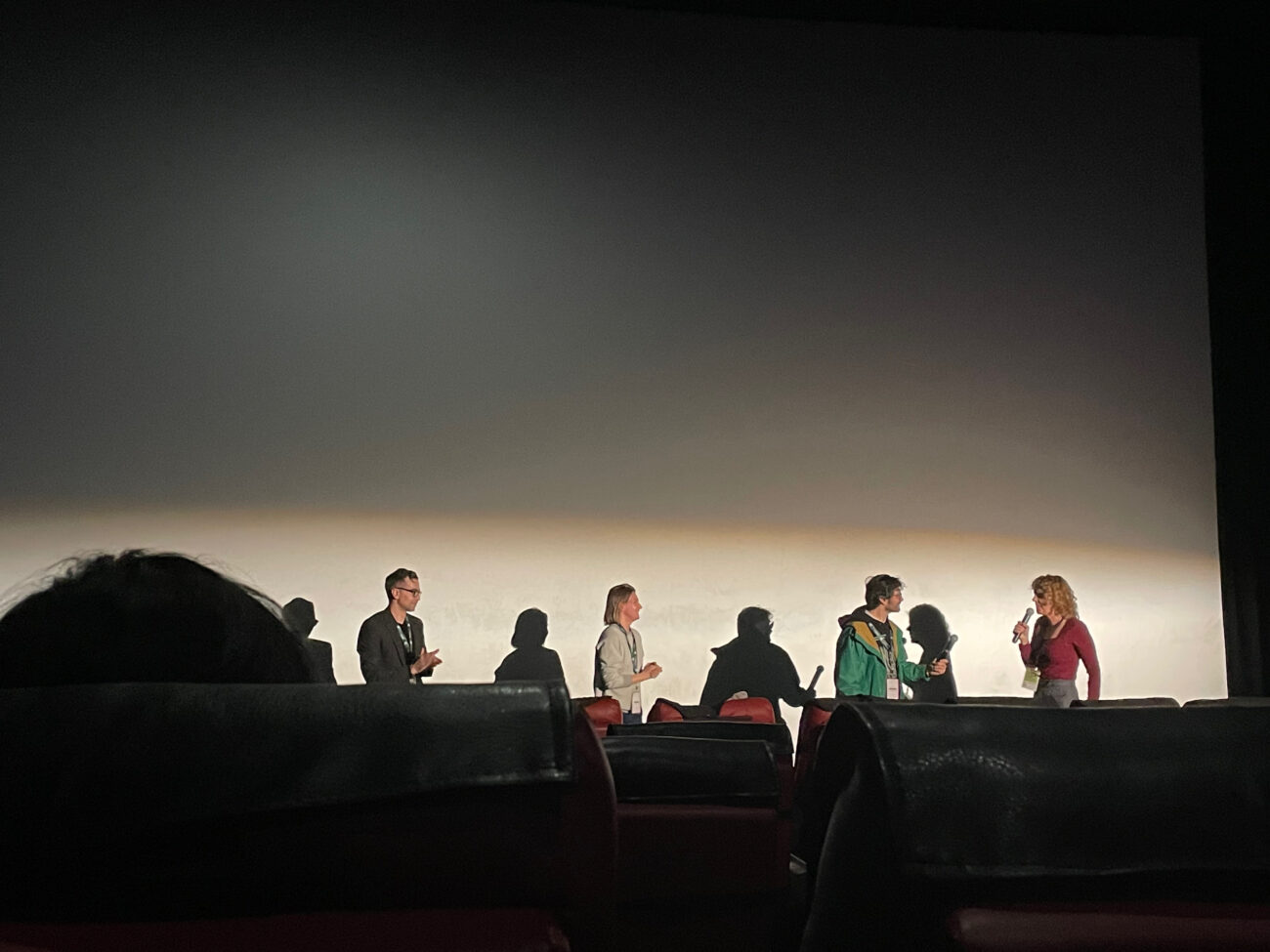
Love rarely comes easy — especially in the worlds imagined by this year’s SLO Film Festival short films. On Sunday night at the Downtown Centre Cinemas, audiences were taken on an emotional journey through stories of longing, loss, and unexpected connections.
The evening’s program, titled “Love in a Hopeless Place,” featured short films that reimagined love in the most unlikely settings: a high school romance inside an assisted living facility, a dystopian society where kissing is punishable by death, and a sculpture park where a woman falls in love with a statue. Each story explored how love can survive, even in environments designed to extinguish it.

“Shangri-La”
Directed by Rhys Raiskin, written by Rhys Raiskin and Hannah Rice
Set in an assisted living facility, “Shangri-La” tells the story of Max, an elderly man who finds himself navigating a crush. Inspired by Raiskin’s grandfather after being widowed and relocated to an assisted living facility, the film plays like a high school rom-com — only with walkers and bingo instead of prom and lockers.
“At first, [my grandpa Joe] was upset about it,” Raiskin said. “But when he got there, he was happy. I went to visit him and it was like he was reliving high school. He showed us what groups sit where, who not to talk to, and also surprised to hear that love is still being built in these places.”
Max develops a crush on a new resident and turns to his closest friend, Alma, for advice. Alma offers him tips, like to join his crush on her favorite activities or ask her to dance, but Max struggles to follow through. Focused on his infatuation, he fails to realize that Alma herself has been quietly falling for him.
By the time Max gains the clarity to see what he had with Alma, it’s too late. Alma passed away; her passing is a poignant metaphor for love lost too soon. It’s a tender twist on the classic coming-of-age tale, only this time it’s coming-of-late-age.
“I would love to find a writer who has the same humor as me to expand this short as a feature film,” Raiskin said.
Rasikin hopes to delve deeper into the romantic lives of seniors — a topic he feels is rarely explored in film.
“Two People Exchanging Saliva”
Directed and written by Alexandre Singh and Natalie Musteata
In a surreal society where dental hygiene is forbidden and kissing is outlawed, “Two People Exchanging Saliva” uses absurdity to explore repression, queer desire, and distorting wealth, power and privilege. In this world, currency is measured in slaps to the face, meals require garlic and onions, passing a security checkpoint is measured by the smell of your breath, and kissing is a crime punishable by death.
Angine, a lonely woman, becomes infatuated with Malaise, a salesgirl at a department store. For 10 days, Angine visits daily, purchasing jewelry and dresses. After each sale, Malaise slaps Angine according to the item’s cost — a bizarre yet strangely tender ritual in a world devoid of touch.
As their relationship deepens, Malaise’s jealous coworker reports her to the authorities after overhearing her brush her teeth — a dangerous act that suggests a desire to kiss Angine. Malaise is arrested and executed.
Angine is devastated. In a haunting scene, she seeks out Malaise’s body and kisses her for the first time — a forbidden act, but one that finally gives her the connection she longed for.
“The film is about queerness,” said Singh. “But it’s not that they’re two women that is the problem, it’s the kiss that’s criminal in this world.”
The creative team hopes to expand the short into a feature, aiming to further explore the dystopian world and its commentary on repression, desire, and control.
“Heart of Stone”
Directed by Tom Van Avermaet, written by Allison Kathleen Kelly
Set in a sculpture park where art and reality blur, “Heart of Stone” tells the story of Paula, a living statue performer who has fallen in love with a stone sculpture named Agatha. Each night, Paula visits Agatha in the park, speaking and admiring her. Their connection is one-sided — or so it seems.
But as the city begins replacing classical sculptures with modern art installations, Paula’s world starts to crumble. One day, Agatha is gone, replaced by a sleek new piece. “The older you get, the less people want you in their lives,” says the worker overseeing the removal — a line that echoes the film’s theme of fading beauty and love.
In a burst of grief, Paula kisses Agatha’s statue, which brings her to life. The two women share a brief, magical romance. Paula introduces Agatha to the modern world, including the isolating reality of social media and the loneliness that can come even when surrounded by people.
As quickly as she came to life, Agatha begins to turn back to stone. But their love endures; one final kiss freezes them both in stone, immortalizing their bond in art.
Love in impossible places
Despite their wildly different settings, each of the films in “Love in a Hopeless Place” asked the same question: What does it mean to love when the odds are stacked against you?
Whether in the sterile halls of a care facility, the oppressive rules of a dystopia, or the silence of stone, love still finds a way to bloom.

