
“The lifeblood of the economy”: Cal Poly faculty join higher education movement
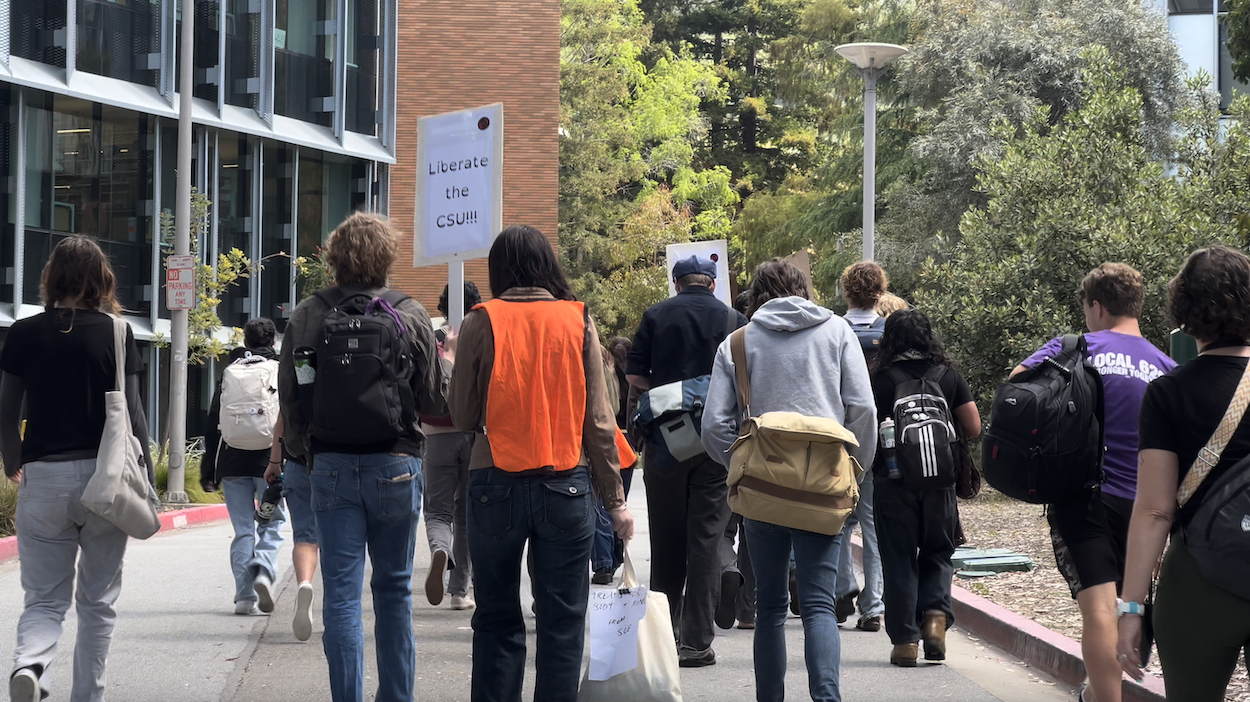
Cal Poly joined over 100 universities across the country on April 17 for a National Day of Action for Higher Education. Students and faculty protested state budget cuts and free speech restrictions on campus.
Cal Poly economics lecturer Solina Lindahl said that despite a 34% tuition increase over five years, the money isn’t going where students need it most.
“Money that’s raised in that tuition has been spent towards capital improvements, administrative costs, etc,” said Lindahl. “The only portion of the budget that’s dropped in the last five years is funding for academic instruction.”
Members of the California Faculty Association (CFA) set up outside of the 1901 Marketplace to advocate for faculty and students. Tad Walters is a lecturer in the English department and co-chair of faculty rights for the CFA.
“Most of us, myself included, are struggling to get by on a daily basis because of inflation,” Walters said. “The money needs to go to instruction, to students, while also not raising tuition.”
Walters also cited academic freedom and free expression of ideas as more reasons he came to the demonstration.
Faculty spoke about how national changes have been impacting them and their students. Cameron Jones, a lecturer in the history department, said his research grant might get canceled.
“I recently received a federal grant, the national endowment for the humanities fellowship,” Jones said. “It hasn’t been canceled yet, but it hasn’t been funded yet. So it should have been funded about three months ago, we’re still waiting to hear.”
Due to the delay in his funding, Jones has not been able to pay students working for him this quarter. He says he wants the California government to stand up against the federal government and make up for lost funds.
“The lifeblood of the economy of the United States is universities,” Jones said. “Not only do we train the future workers in all the industries that they’re talking about of the future, high tech, engineering, but, the research we produce is usually what U.S. companies use for their own innovations. Cutting this funding is going to just hurt the economy in the United States and hurt Americans.”
For Lindahl, the stakes are clear.
“We believe in the beauty of higher education,” she said. “We believe in the power and the social mobility and the promise for what it means for our California students that are going to need it more than ever.”

