
Ayla Boose is a content writer and disc jockey for KCPR. The opinions expressed in this article do not necessarily reflect those of Mustang Media Group.
During my intermittent doom scroll breaks in the months leading up to the new year, a rise of a so-called “physical media movement” slowly took over my feed. Ironic. Posts claimed that starting Jan. 1, a switch to the traditional love language of inconvenience will commence in what appears to be a rebellion from the oversaturated culture of curated, algorithm driven consumption.
Instead, a narrative to shine light on the hobbies you’ve dreamt of engaging in is characterized by a slew of videos encouraging viewers to start a band, try the recipe they’ve had bookmarked for three months, pick up a magazine, give a friend a phone call or redecorate in place of scrolling.
It’s no secret that people have turned back to the nostalgia of physical media and intentional choice. I remember the signs starting with the popularization of thrifting, vinyl walls and my best friend’s brother’s pretentious obsession with cassettes in 2021.
Sometimes I feel paralyzed with too much choice, like the autonomy over choice in even the littlest things like music or movies was lost to algorithms trying to guess my next move. Algorithms that are meant to try their hardest to steal your attention with no regards as to the snowball of wasted time and shortened attention spans.
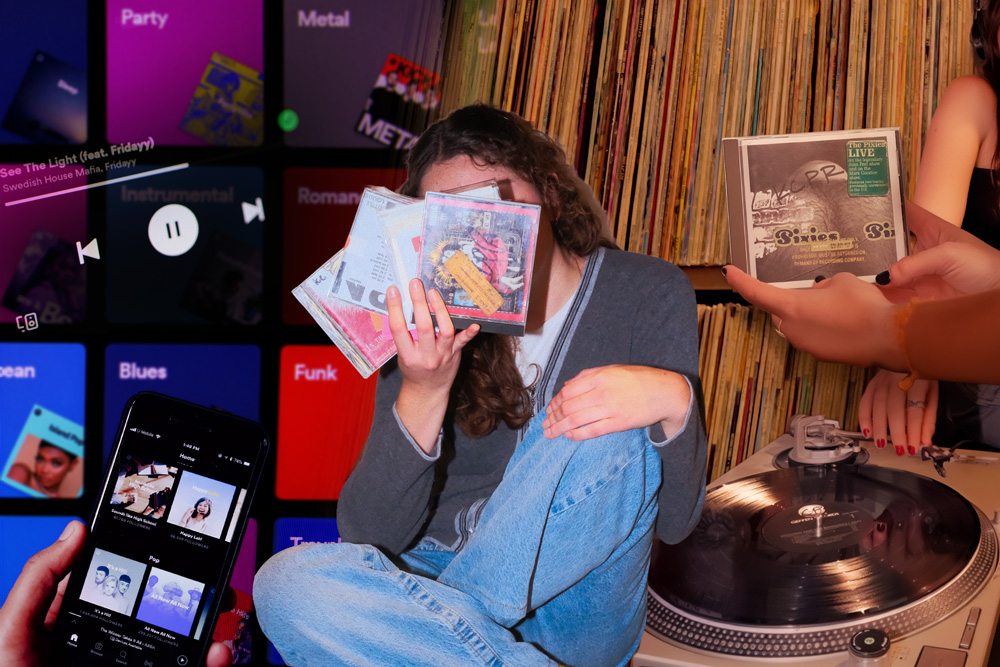
I think that’s why the physical media that makes up KCPR’s music library is so important. As radio DJ Lucky Strike, it feels like the most intimate form of connecting with the songs I choose to play on air. One of the best parts about being a DJ is dipping into the stacks of records or finding my a CD of my favorite album. It always makes playing it mean that much more.
Being able to hold a record in my hands and watch as the needle scratches its surface is a satisfaction you can only get with physical music.
DJ Dylanesque agreed that one of the best parts about using physical media for his shows is the hands-on nature that it allows for.
“It’s fun! You get to use your hands. You get to smell rotting paper. You get a little rush when the needle finds the grooves and all of sudden there is music playing,” he said.
Grrrl Scout highlighted physical media’s role of being a medium that connects us.
“It forces attention to quality and detail, and it forces the listener to take something in as an entire art piece rather than single by single,” she said. “Physical media allows us to be connected in a way that streaming can never, and what is the point of music but to be connected?”
Using physical media also keeps the excitement of music discovery alive.
“There are so many awesome deep cuts in the physical library and also browsing the stacks is a great way for me to find new music to listen to,” said DJ Magpie. “By maintaining a collection of my own, I have more freedom to play the music that’s special to me on my shows.”
Physical media will most likely always be around. If this particular movement will stick around, however, is up for debate. Some argue people will come to their senses about the intimate value of physical music while others say that people are simply too attached to their streaming apps to fully graduate to a completely analog style.
Either way, physical media “provides access to music like no streaming service can,” DJ Twenty Seven said.
Even Letterboxd, the film review and rating app, has released articles about ways to reconnect with physical media and its sentimental value. It seems a lot of signs are pointing to physical media, but with the underlying reason: intentionality.
It’s what seems to be at the core of this new-old obsession with physical media of any sort. Speaking to a cultural shift and awareness of current factors, like streaming services and social media, and how they affect choice.
In a reality of too many choices, it seems physical media might be the start to a life of choice driven by intentionality, personal flair and reverence.

