
Men have more places to pee in Cal Poly’s academic buildings
This is a cross-published piece with Mustang News, more information can be found here.
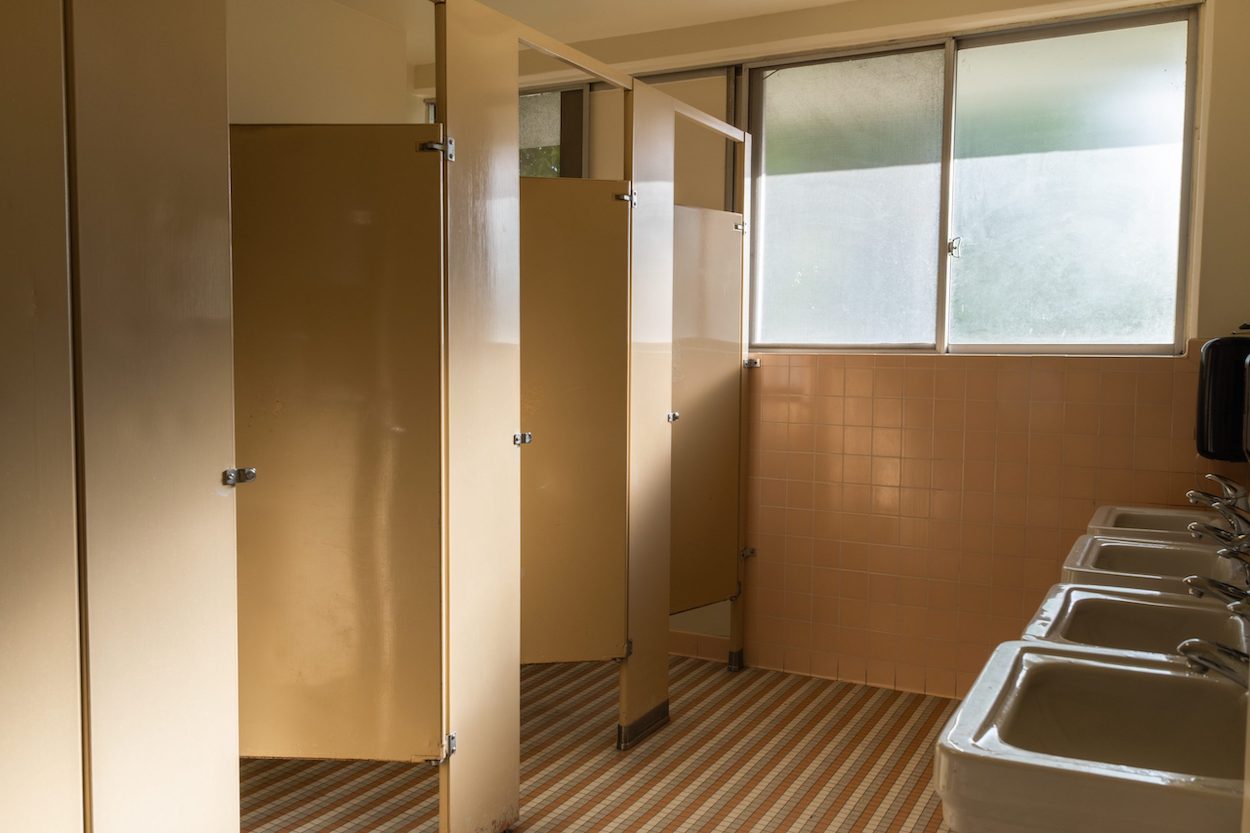
Ellie Miller spends most of her time in the Erhart Agriculture building. In the 10 minutes before class or the second after classes end, the agribusiness senior and other female students often have to wait in long lines to use the restroom.
“During rush hour between classes, the line goes out the door all the way [down the hall],” Miller said. “Everybody wants to jump in and use the bathroom. If you really have to go, you have to run downstairs and try to use the two-stall women’s bathroom.”
Within Cal Poly’s academic buildings, women often have fewer restroom stalls. The university tracks the number of restrooms but not the individual number of places to pee, according to university spokesperson Keegan Koberl.
Mustang News counted restroom stalls in campus buildings. The agriculture building has three men’s and two women’s restrooms. The men’s restrooms have a total of nine stalls and 11 urinals. The women have access to six stalls throughout the building.
In older buildings, such as Graphic Arts or Mathematics and Science, men have access to more places to urinate. Some, like Engineering East, offer women less than half as many stalls.

In newer buildings like Frost Center and Engineering IV, men and women have equal restroom access. Engineering IV has five urinals and seven stalls for men, and 12 stalls for women.
Miller often leaves class a little early or drops off her stuff quickly to get to the restroom before the line forms, but she and many of her female friends have been late to class waiting for the restroom.
“I think that it was probably a design flaw,” Miller said. “I don’t think they would have intentionally done that to the students, but we’re paying for it.”
Female enrollment rises but restrooms don’t
Cal Poly has historically served a predominantly male student body. Women were the majority, just over 50% for the first time in 2023, according to Institutional Research data. Cal Poly originally opened with a co-ed student body of 15 students in 1903, but state legislation in 1929 barred women from enrolling for 27 years, according to Cal Poly Fact Books. Most of Cal Poly’s buildings were constructed when there were more male students.
“Some buildings on campus were designed and built in the 1950s when Cal Poly was a male-only campus, which creates issues that need to be addressed,” Koberl wrote in an email to Mustang News. “The campus is engaging in an update to its accessibility transition plan to better outline the plan to remove barriers on campus and secure funding to upgrade restrooms, among other things, to provide better inclusivity for all.”
Women represent more than half of Cal Poly enrollment, but in certain colleges they have a larger majority. In the College of Liberal Arts, women make up nearly three quarters of students, according to Institutional Research. This means in buildings dominated by liberal arts students, like the Graphic Arts Building, restroom inequity becomes more visible.

The journalism and graphic communications departments share Building 26, and the women who dominate the majors share three stalls. The men have access to more than triple the places to pee.
Graphic communication senior Kathryn Grossenbacher says there are only a couple of boys in each of her classes. She has never been late to class because of the restroom but says she has to plan around the line.
“There’s definitely times that are more difficult to go, like passing periods,” Grossenbacher said. “I’ll normally choose not to go during that time. I know there’s always going to be a long line in between classes and during those transition periods.”
Grossenbacher does not believe Building 26 is Cal Poly’s biggest priority and does not expect changes to be made to the restrooms. But, she feels generally supported as a female student.
“It’s just little things, like the bathroom situation, that’s a little disappointing,” Grossenbacher said. “Other than that, I feel like all the staff and community is really supportive. I feel generally supported.”
This issue is not unique to the College of Liberal Arts. The College of Agriculture, Food and Environmental Science is over 60% women, but a main building for the college, Erhart, was designed during a time where men dominated the enrollment.
Urinals deter some in all-gender restrooms

All-gender restrooms increase access to places to urinate and create a safe space for students of all gender identities, according to the university. In Baker Center, there are 14 all gender places to pee, in addition to the 25 men’s and 25 women’s fixtures.
Yet, in the all gender restrooms, some female students do not feel comfortable using the facility with urinals. Female agribusiness sophomore Morgan Arendt does not mind gender-neutral restrooms but usually avoids the ones with urinals.
“I just don’t want to be around men who are using the urinals,” Arendt said. “I typically would go to one without urinals personally. I don’t mind gender-neutral bathrooms themselves though.”

In 2023, the university began converting gendered restrooms into all-gender facilities, according to previous Mustang News coverage. The university created a guide to all-gender facilities.
Much like female students opting to use the all gender restrooms with only stalls, male communications senior Zeke Lefton said he uses the all-gender restroom with urinals to avoid making women uncomfortable.
“I typically go into the ones with urinals just out of fear of making someone uncomfortable,” Lefton said. “What they should do is get rid of all the urinals if they’re going to [convert restrooms to all gender] and put in more stalls.”
Lefton said he has never seen a line to use the men’s restrooms. He did not realize there were so few places for women to urinate and never put thought into women’s restroom availability.
“At the very least, even if you factor out the urinals, there should be the same amount of stalls,” Lefton said. “It makes no sense that there would be more stalls and urinals in the men’s bathroom.”

