
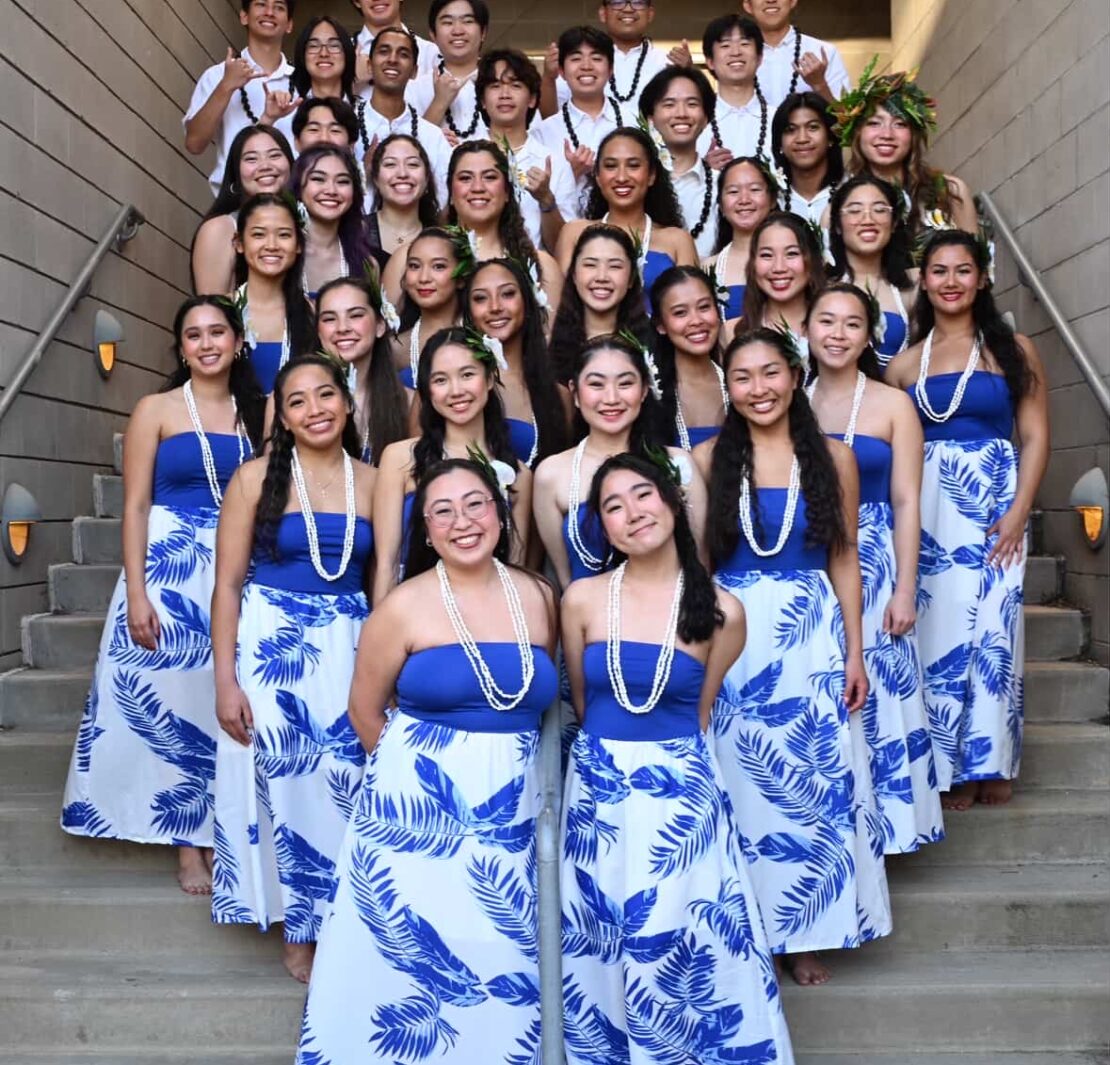
Tucked away in Studio 3 of the Cal Poly Rec Center, a soft lull of Hawaiian music and the patter of bare feet can be heard — a staple of the Pacific Islander community at Cal Poly, Hui O’ Hawai’i‘s hula team practices. Comprised of dancers of all grades, majors and identities, it’s a collection of individuals all united under one form of storytelling.
“Hula is just so special because it’s such an old and traditional way of dancing,” said architecture junior and hula coordinator for the team Xia Ota. “It’s a language that anyone can understand.”
Starting from a team of roughly a dozen members her freshman year, Ota has consistently worked to increase this number, inviting students to both dance and connect through potlucks, game nights and other bonding activities.
Doubling in team size from 2023 to 2025, the Hula team is still working tirelessly to get their stories heard. At a school where the Pacific Islander population barely totals 0.3 percent, this task can feel daunting.
“It sheds light on what Hawai’ian, Polynesian, Pacific Islander and Islander culture is about, at a place where it is predominantly white and lacks cultural identity,” said Ota.
Celebrations of Islander culture are few and far between at Cal Poly, and rely heavily on club support to stay alive.
Wine and viticulture sophomore Riah Leoiki said, “Hawaiians use it to tell their stories because prior to Western contact, we didn’t have a written language. It’s how we tell our history and keep our culture alive.”
With each simple motion of the palm, or tilt of the head, dancers are actively contributing to intricate descriptions of living history. The rhythm lasts generations, connecting dancers of today to stories from hundreds of years ago.
For one dance, Ota said the team created a whole world, telling the story of “all the four waters, the different rivers Waikapu, Wailuku, and how those rivers come together and make Maui what it is.”
Through this elaborate storytelling, dancers feel less homesick, bringing a piece of Hawai’i all the way to the Central Coast.
“Coming up here to Cal Poly, it was a way to connect back to home,” said Ota.
The team has found a way to channel the islands’ culture, history and identity, building a community of support in the process.
Leoiki said if the team could be summarized in one word, it would be “family.”
“It’s about storytelling,” said Ota. “Tt’s a way for people to connect, no matter who you are.”

