
Opening a can of confidence: Can of Worms Comedy Club lets students find their comedic voice
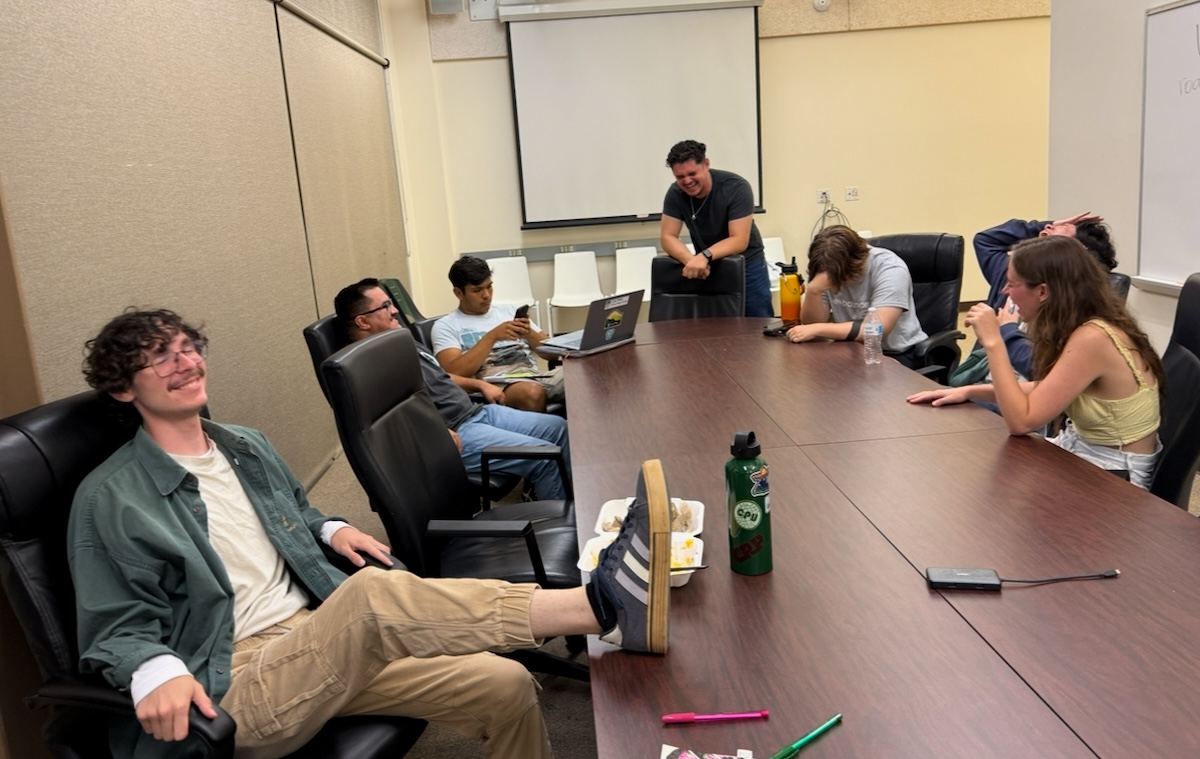
Stand-up comedy at Cal Poly doesn’t always begin on a stage. For members of Can of Worms Comedy Club, it often starts in a conference room, where students sit around a table and talk through ideas, jokes and personal stories. For many students, Can of Worms Comedy Club serves as a starting point in their comedy journey.
Founded last spring, the club was created to give students a place to experiment with stand-up comedy before performing in front of a live audience. Club president Jules Wood said the goal was to rebuild a stand-up-focused space that had disappeared from campus over time.
“I want to create a place where people can sort of work out their ideas and gain confidence before they sort of make the leap to go on stage,” said Wood.
Unlike other comedy organizations on campus, Can of Worms does not rely on auditions or structured rehearsals with its members. Meetings are intentionally loose, allowing conversations to evolve naturally into material. Members often begin by catching up about their week, which usually evolves into shared jokes or bits as others jump in.
Wood said the club is meant to complement, not compete with, Cal Poly’s improv and sketch comedy groups by offering students a different creative outlet. Rather than working in groups or following scripts, performers focus on developing their own voice.
That approach has helped some students feel more comfortable trying comedy for the first time. Experience industry management freshman James Ramsey joined the club in hopes of meeting new people, not necessarily to perform. After attending one of the club’s shows, he realized stand-up felt more approachable than he expected.
“All of the stand-ups were really good, but they were all good in a way where I was like, I can do this,” Ramsey said.
For Ramsey, who describes himself as introverted, getting on stage for the first time was intimidating. He said the workshop setting made the process feel less overwhelming by allowing him to test jokes in a smaller group first.
“Having this as a space where I can talk through a joke before I say it in front of an audience is really helpful and takes away some of the fear,” Ramsey said.
Balancing comedy with academics is another challenge many members face. History senior Angel Lopez said coursework often limits how much time he can dedicate to performing.
“Right now I’m writing like a 35-page essay,” Lopez said. “It’s hard balancing school and comedy, but it’s really rewarding.”
Environmental engineering sophomore Marco Matolonggo said the club’s focus on individual perspective is what sets it apart.
“In this club, it’s more about bringing out what’s funny about you,” Matolonggo said. “I can just do what I think is funny directly to the audience.”
Matolonggo added that stand-up offers immediate feedback, something he finds motivating.
“With comedy, you know you’re doing well because you can hear people laughing,” he said.
Failure, members say, is part of the process. Ramsey said learning to accept that a joke may not land is essential.
“You kind of have to be okay with the idea of bombing,” he said.
Wood said that mindset is why the club remains open to anyone interested, regardless of experience level.
“It doesn’t have to be good. Doesn’t have to be funny. It just has to be something,” Wood said.

